
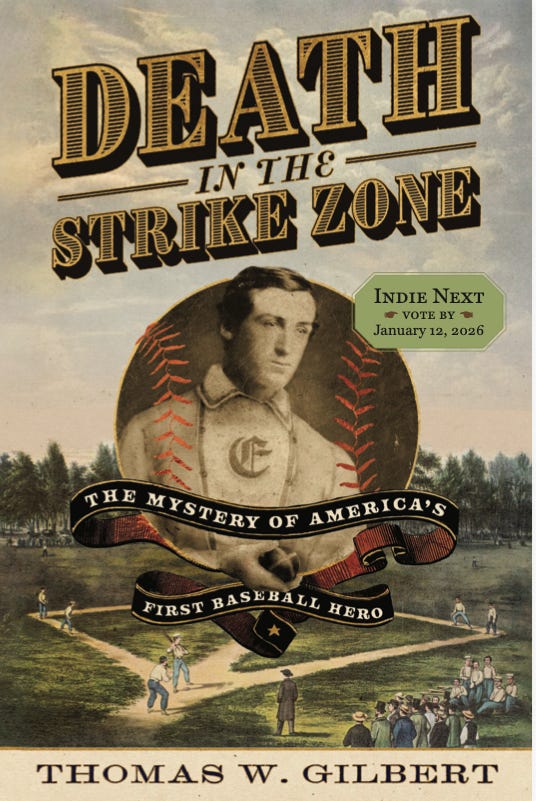
My new book — the first biography ever written of baseball’s first pitcher and first national star — is a work of history, not fiction, but I call it a mystery.
In fact, the James Creighton story is made up of many mysteries. The first and most baffling is how a player who revolutionized the game of baseball more than Babe Ruth is so little known today.
In the beginning of the book I offer the following list of Creighton baseball firsts.
He pitched baseball’s first shutout. He was not only the best baseball player of his day, but the best American athlete, period. He was such a rare talent that two sports changed their rules for him. When he joined the Brooklyn Stars, a youth club, they immediately began beating the best adult clubs. This has no parallel. There is no major league superstar who, if he were added to, say, a college team, would make it competitive with the New York Yankees.
Today, an immense stream of prospects is supplied to pro sports by a vast scouting and development machine whose tentacles reach around the globe. If a 14-year-old pitcher lights up a radar gun in Boise, San Pedro de Macorís or Taipei, someone in organized baseball knows about it. James Creighton was the first youth athlete who was recruited by an American team sport. He was literally the first baseball “phenom” and the first player to be called that.
There were players who were called pitchers before Creighton, but he was the first pitcher in the modern sense of the word, that is, the first to serve as a decisive defensive weapon. When Creighton played, pitchers threw underhand on flat ground. Instead of taking one stride from a pitching rubber, they ran up to a line before delivering a pitch.
All fielders in Creighton’s day played barehanded. Balls could be caught on one bounce for an out. Catchers of this era were the last iron men — they stopped pitches and caught foul tips with no gloves, no face mask, and no shin guards or padding of any kind. James Creighton’s catcher, Joe Leggett, had it tougher than most because of Creighton’s sheer speed. Two years of catching Creighton left Joe Leggett crippled.
James Creighton threw the first fastball that deserved the name. Creighton, not Hall of Famer Candy Cummings, threw the first curveball. Some of Creighton’s contemporaries assumed that he was cheating because he was so dominant, but he wasn’t cheating.
Baseball has exploited and overused too many pitching arms to count, but Creighton was first in this as well. He was the first to have his health ruined by pitching — and the first to lose his life.
Rumor also had it that Creighton was paid, which would have been another kind of cheating, because in his time baseball was amateur and paying players was against the rules. If true, this is probably another first.
Creighton was the everyday pitcher and number-one attraction on the Excelsiors of Brooklyn, a club that was put together to make baseball our first national sport. The Excelsiors took the game from its birthplace, the New York City metropolitan area, by railroad, canal and steamship to upstate New York and America’s other big cities: Philadelphia, Baltimore, and Boston. Baseball’s first-ever road trips, these expeditions
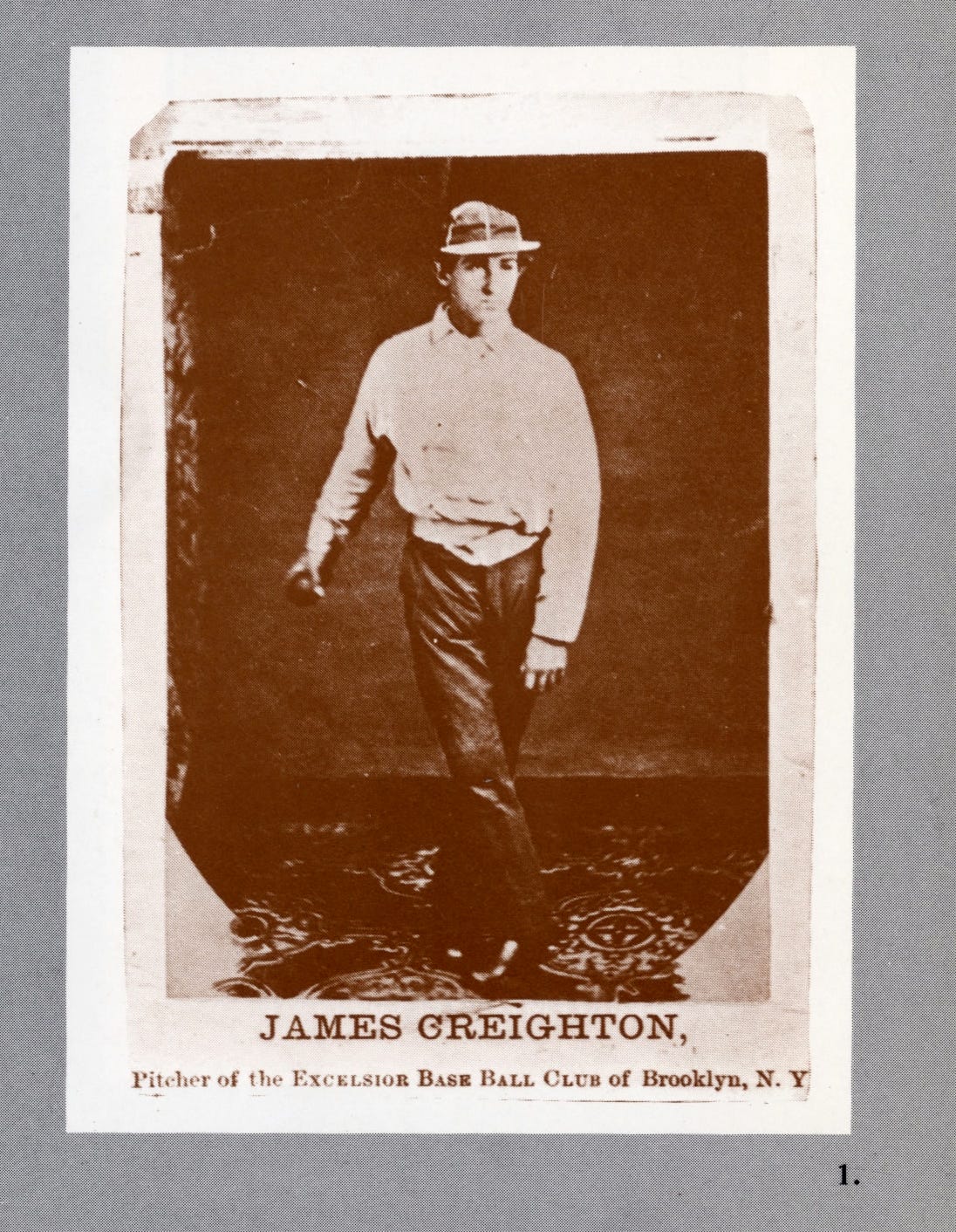
This image of James Creighton appears on what many consider the first baseball card, reproduced and sold to public in the mid-1860s. It is a posed studio shot, but it shows us the start of the twisting, one-stride delivery that enabled Creighton to throw with unheard-of velocity.
It may also have killed him.
============================================================================
showed the rest of the nation how exciting baseball could be when played bysuperior athletes. The Excelsiors’ tours led straight to the founding of the first national baseball leagues, which became the model for almost every professional sports league in the world.
Even this litany of firsts sells him short. Understanding baseball and how it became our first national team sport starts with the mystery of James Creighton.
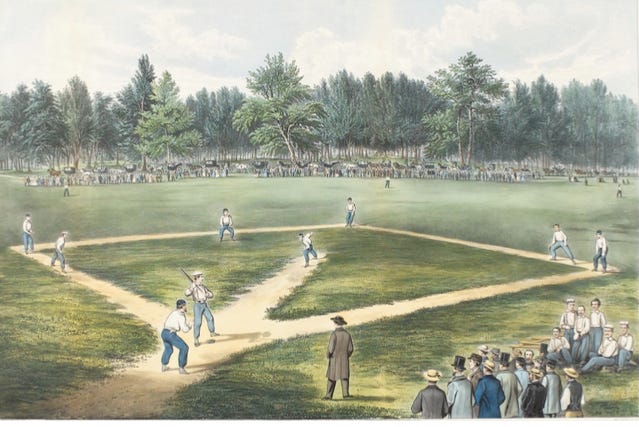
An imaginary game at the Elysian Fields in Hoboken c. 1860 with a very real James Creighton pitching.
What a great subject for a book. James Creighton is the kind of forgotten figure baseball history undersells, a true first who never gets mentioned alongside Ruth or Cy Young despite arguably changing the game more. The detail about two sports changing their rules for him is fascinating on its own. Excited to read the book.